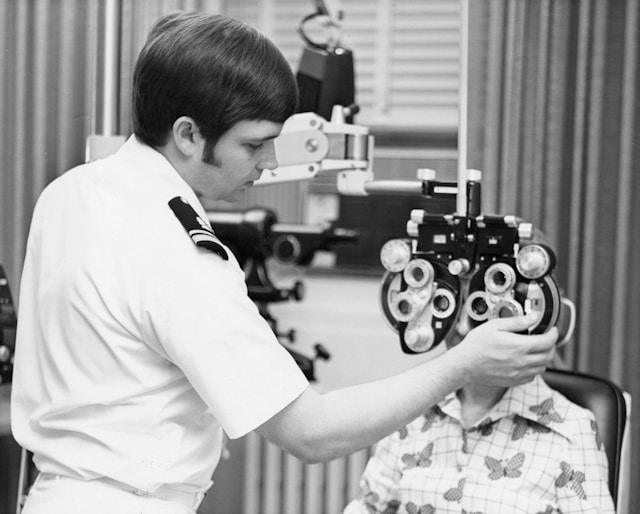
If you have ever sat in an eye doctor’s chair, you know the familiar question: “Better or worse?”
A new lens drops into place, and suddenly the blurry world sharpens—or it doesn’t.
We ask that same question every day with our lives, even when we do not realize it. Better or worse? Safer or riskier? Threatening or promising? Worth noticing or easy to dismiss? The lens may be invisible, but it is always shaping what we see.
None of us experiences life like a neutral camera. We see through expectation, memory, desire, fear, pain, and hope. One person sees a setback and assumes failure. Another sees the same moment and notices possibility. The event may be the same, but the lens is different.
That is why you start seeing black Corvettes everywhere after you decide you want one. They were always there. Your attention simply changed. The same thing happens with opportunity, criticism, conflict, and disappointment. We tend to notice what our inner world has already been trained to look for.
Some lenses are easy to name. Grief is a lens. Ambition is a lens. Past hurt is a lens. Insecurity is a lens. Even optimism can be a lens. A lens is not always bad, but it always highlights some things while pushing others into the background.
The hardest lens to recognize is often the one formed by expectation. When you expect rejection, you start gathering evidence for it. When you expect growth, you interpret hard moments differently. When you expect someone to let you down, you may overlook the ways they are genuinely trying.
That is why awareness matters so much. You may not be able to remove every lens, but you can learn to name the one you are using. And once you name it, you are no longer quite as controlled by it.
Shift/Insight
Growth does not only come from changing your circumstances. Sometimes it comes from noticing the lens you keep bringing into them. A clearer life often begins with clearer seeing.
Today’s Nudge:
Choose one situation that feels emotionally charged right now. Finish this sentence honestly: “The lens I may be using is…” Then ask yourself: “What might someone with a healthier lens notice that I am missing?”
Faith Connection
Scripture reminds us that we do not always see clearly on our own. Our perceptions can be limited by fear, pride, hurt, or assumption. That is why we need God’s wisdom, not just our own perspective. Proverbs 3:5 says, “Trust in the Lord with all your heart and lean not on your own understanding.” That is not a call to ignore your mind. It is a call to let God correct your lens.
Faith invites us to ask better questions: Am I seeing this through fear or through trust? Through offense or through grace? Through self-protection or through truth? When we bring our perspective before God, He often does not change the situation first. He changes the way we see it.
Sometimes the breakthrough is not that life suddenly looks easier. It is that, through God’s help, you begin to see more honestly, more humbly, and more clearly. And clearer vision can change everything.